

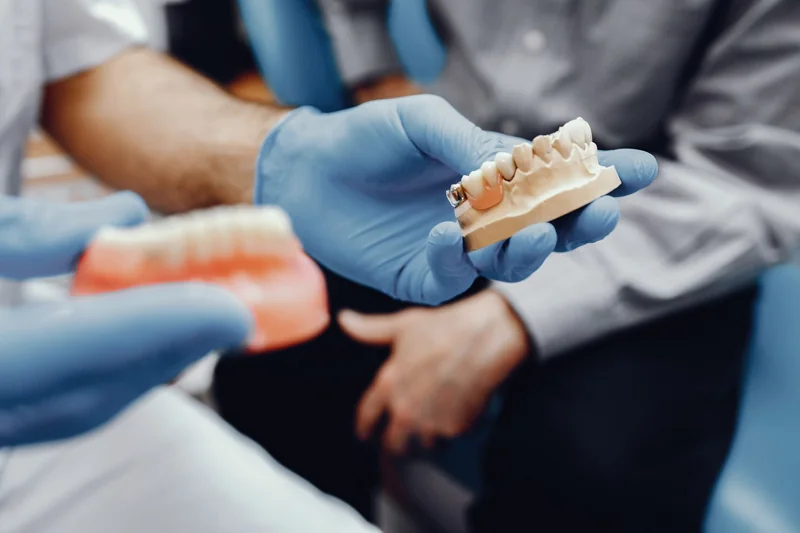
A gap from one missing tooth rarely stays “just a gap”. Food starts packing into it. Chewing feels uneven. The tooth above or below may begin to move. The teeth beside the space can slowly tilt.
For one missing tooth, most people compare two fixed options: a single tooth implant or a dental bridge. Both can look natural. Both can restore chewing. The better choice depends on the teeth beside the gap, the bone under it, your gum health and how much daily care you’re prepared to do.
An implant stands alone; a bridge depends on nearby teeth
A single implant replaces the missing tooth root with a small titanium fixture placed in the jawbone. After healing, a crown is attached so the tooth can function and look like part of your natural smile. We explain the basic process in our guide to how dental implants replace missing teeth.
A bridge works differently. The replacement tooth sits in the gap, but it gets support from the teeth on either side. In a traditional bridge, those neighbouring teeth are shaped for crowns, and the false tooth is joined between them.
That difference matters. A dental implant asks more of the bone and healing process. A bridge asks more of the adjacent teeth.
The condition of the neighbouring teeth often decides the answer
If the teeth beside the gap are healthy, strong and mostly untouched, an implant often makes more sense. It fills the missing tooth space without reshaping healthy enamel on either side.
That’s a big deal. Natural tooth structure is not something we like to remove without a strong reason. Once a tooth has been prepared for a crown, it may need more maintenance over its lifetime.
A bridge can still be the better option in the right mouth. If the teeth beside the gap already have large fillings, cracks, old crowns or structural weakness, using them as bridge supports may solve more than one problem. In that situation, the bridge is not “damaging perfect teeth”. It may be restoring teeth that already need help.
So the question is not simply: “Which option is better?”
The better question is: “Which option protects the most healthy tooth structure in this mouth?”
Implant and bridge survival rates only tell part of the story
Patients often ask which option lasts longer. The honest answer is more useful than a neat one.
A systematic review on single implant crowns reported strong five-year survival for implants supporting single crowns and for the crowns themselves. That sounds reassuring, but the same review also discussed complications such as screw loosening, crown material problems and gum-related issues around implants.
Bridges also have good evidence behind them. A review comparing tooth-supported bridges and implant-supported restorations found high five-year survival across several fixed replacement options. The difference was in the type of problem each option tended to face. Bridges were more exposed to biological issues involving supporting teeth. Dental Implant restoration in Sydney had their own technical and tissue-related risks.
That’s why survival numbers should not be used alone. A treatment can “survive” and still need repairs, cleaning support, bite adjustment or future work. The better choice is the one with risks that suit your mouth and your habits.
Quick comparison: single tooth implant vs dental bridge
| Question | Single tooth implant | Dental bridge |
| Does it involve nearby teeth? | Usually no | Usually yes |
| Does it need surgery? | Yes | Usually no implant surgery |
| Does it need enough jawbone? | Yes | Less dependent on bone at the gap |
| Is cleaning simple? | Similar to a tooth, with careful gum care | Needs special cleaning under the bridge |
| Best suited to | Healthy adjacent teeth and stable bone | Adjacent teeth that already need crowns |
This table is only a starting point. X-rays, scans, gum health, bite pressure and medical history can change the recommendation.
Bone and gum health can overrule preference
Some people arrive already wanting an implant. Others want to avoid surgery and ask for a bridge straight away. We understand both reactions.
Before recommending an implant, we check whether the jawbone can support it, whether the gum is healthy, whether infection is present and whether your bite puts too much force on the missing tooth area. We talk through these suitability factors in our guide on how to know if dental implants are right for you.
A bridge also needs careful planning. The supporting teeth must be strong enough to carry the extra load. If one of those teeth is already weak, building a bridge on top of it can turn a one-tooth problem into a larger one later.
This is where a proper assessment matters. The mouth decides more than the marketing does.
Cleaning is where many good plans succeed or fail
A single implant crown does not decay like a natural tooth. The tissue around it can still become inflamed. If plaque sits around the implant, the gum and bone can suffer.
A bridge brings a different cleaning challenge. Because the replacement tooth is joined to the supporting crowns, you cannot floss through it like a normal tooth contact. Many patients need floss threaders, interdental brushes or other cleaning aids to keep the area underneath clean.
This is not a small detail. A beautiful bridge that traps food and never gets cleaned properly is not a good long-term plan. A well-placed implant in a mouth with active gum disease is not a good plan either.
Daily care is part of the treatment, not an optional extra.
So, which is better for one missing tooth?
For many adults with healthy neighbouring teeth, good gum health and enough jawbone, an implant is often the stronger choice. It replaces the missing tooth without asking the teeth beside it to carry the load.
A bridge may be better if the adjacent teeth already need crowns, implant surgery is not suitable, the bone situation is poor, or the patient wants to avoid a surgical pathway. It can still be a strong fixed option when the supporting teeth are chosen carefully.
The best implant vs bridge decision comes down to four checks:
- Are the neighbouring teeth healthy?
- Is there enough bone at the missing tooth site?
- Are the gums stable?
- Can the patient clean the chosen option properly every day?
That last point is easy to underestimate. Dentistry does the building. The patient protects it.
FAQ
Can a bridge be changed to an implant later?
Often, yes, but the dentist needs to assess the bone, gum and supporting teeth first. If the bridge failed because one anchor tooth decayed or cracked, that tooth may need treatment before an implant plan can be made.
Does an implant feel more natural than a bridge?
Many patients feel that an implant is closer to a natural tooth because it stands alone. A bridge can also feel stable and comfortable, but cleaning and flossing feel different because the teeth are joined.
What happens if I leave one missing tooth untreated?
The teeth beside the gap can drift, the opposing tooth may move into the space, and food may keep catching. We explain the wider effects of missing teeth in our blog on how dental implants could change your life.
At Dental Implant Professionals, we don’t push one option before we’ve looked at the mouth properly. Book a consultation and we’ll check your gum health, jawbone support and neighbouring teeth, then explain whether an implant, bridge or another replacement option makes the most sense for your situation.