

Teeth “in a day” is a catchy phrase, but it speaks to a real need. In Australia, around 8.1% of adults aged 45 and over had lost all of their natural teeth in 2017–18. For people who want fixed teeth rather than a removable denture, All-on-4 dental implants can shorten the gap between surgery and having teeth that look and feel more natural. “Fast”, though, still has rules: not everyone can be loaded immediately, and the first set of teeth is usually temporary.
Teeth in a Day dental implants in Australia: what you actually get on day one
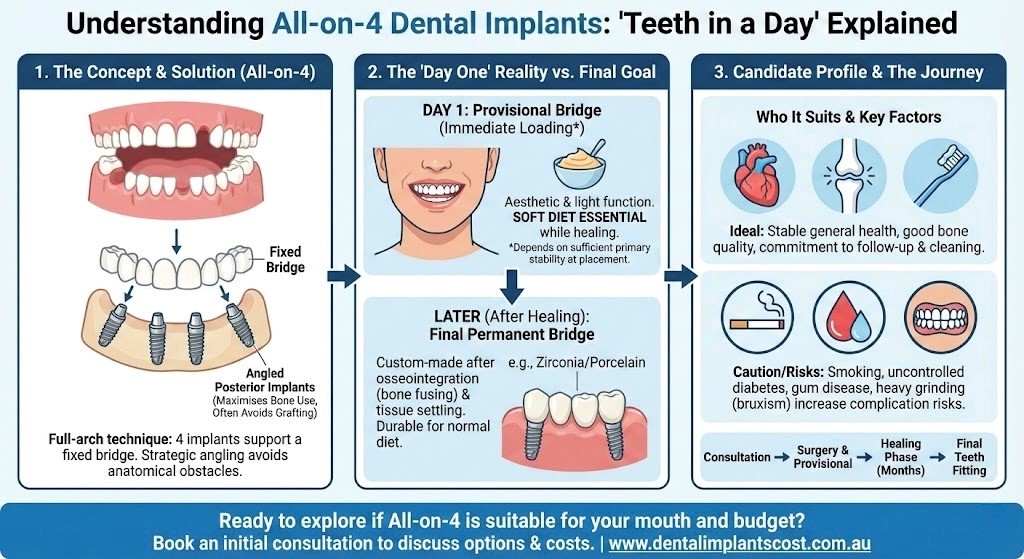
Most clinics use “teeth in a day” to describe placing implants and attaching a fixed provisional bridge soon after.
In the implant world, “immediate loading” generally means the teeth are connected within a week of implant placement. That provisional bridge is designed to get you speaking and smiling straight away, while you keep to a soft diet.
It is not the final product. Final teeth are normally made after healing, once the implants have integrated and swelling has settled.
The All-on-4 concept is often promoted with “provisional teeth in a day”, but immediate function still depends on meeting loading criteria such as sufficient stability at placement. If stability is borderline, a staged approach can be the safer call.
How All-on-4 works
All-on-4 is a full-arch technique that supports a bridge using four implants per jaw.
The typical plan uses two implants toward the front and two at the back, with the posterior implants angled to use available bone and avoid key anatomy.
Angling the rear implants is one reason some patients can avoid bone grafting, which can otherwise extend timelines.
Reviews point to “primary stability”, bone quality, and the absence of active infection as practical requirements. When those factors are not favourable, your dentist may recommend letting the implants heal before fitting a fixed bridge.
Who it can suit, and who should be cautious
All-on-4 often appeals to people who have lost most teeth, have teeth with a poor prognosis, or cannot tolerate dentures.
Candidates tend to do best when general health is stable and they can commit to follow-up care and cleaning.
Some factors call for extra care rather than a flat “no”. Smoking, uncontrolled diabetes, untreated gum disease, and heavy clenching or grinding can raise the chance of complications.
Complications include biological problems such as infection and peri-implantitis, and mechanical problems such as screw loosening or wear of the bridge.
Also Read: 10 Questions to Ask Your Dentist Before Getting Full Dental Implants
Costs and practicalities to ask about
Prices vary because the treatment is a bundle. Planning scans, extractions, sedation, the provisional bridge, and the final bridge material all influence the total.
If you are comparing quotes, ask for an itemised breakdown and clarity on what is included in aftercare, repairs to the provisional, and ongoing reviews.
You may also see full-arch dental implants used as a broader label for several fixed-bridge options, including All-on-4. When choosing, focus on the plan: how many implants, what type of bridge, when it becomes final, and what happens if immediate loading is not advised on surgery day.
Ready to find out whether All-on-4 is suitable for your mouth and your budget? Book an initial consultation through Dental Implants Cost or call 1300 850 072 to discuss your options and next steps.
Frequently Asked Questions:
- Is All-on-4 the same as Teeth in a Day?
Not always. All-on-4 describes a way of supporting a full-arch bridge with four implants. “Teeth in a day” describes timing. Some patients receive a fixed provisional bridge very quickly, while others need healing time first. A good clinic will explain which loading protocol you’re suitable for and why. - Can I really get temporary teeth the same day?
Many people do, but it relies on strong stability at surgery and a risk profile that supports immediate loading. If stability is borderline, your dentist may delay the fixed provisional to protect healing. That decision can feel disappointing in the moment, yet it can reduce early failure risk and save you from repeat surgery. - Who is a good candidate for All-on-4?
People missing most or all teeth, or facing multiple extractions, are common candidates. Better outcomes are more likely when general health is managed, gum disease is treated, and you can keep up with cleaning and reviews. Smoking and grinding do not automatically rule it out, but they can change the plan and the cost. - How long does it take to get the final (permanent) teeth?
Most clinicians wait until healing is well underway before fitting the final bridge. The exact timeframe varies with bone quality, whether extractions were extensive, and how your bite settles with the provisional. Ask for a written timeline that includes review visits and what would extend the schedule.